Gateway to New York - Above it All
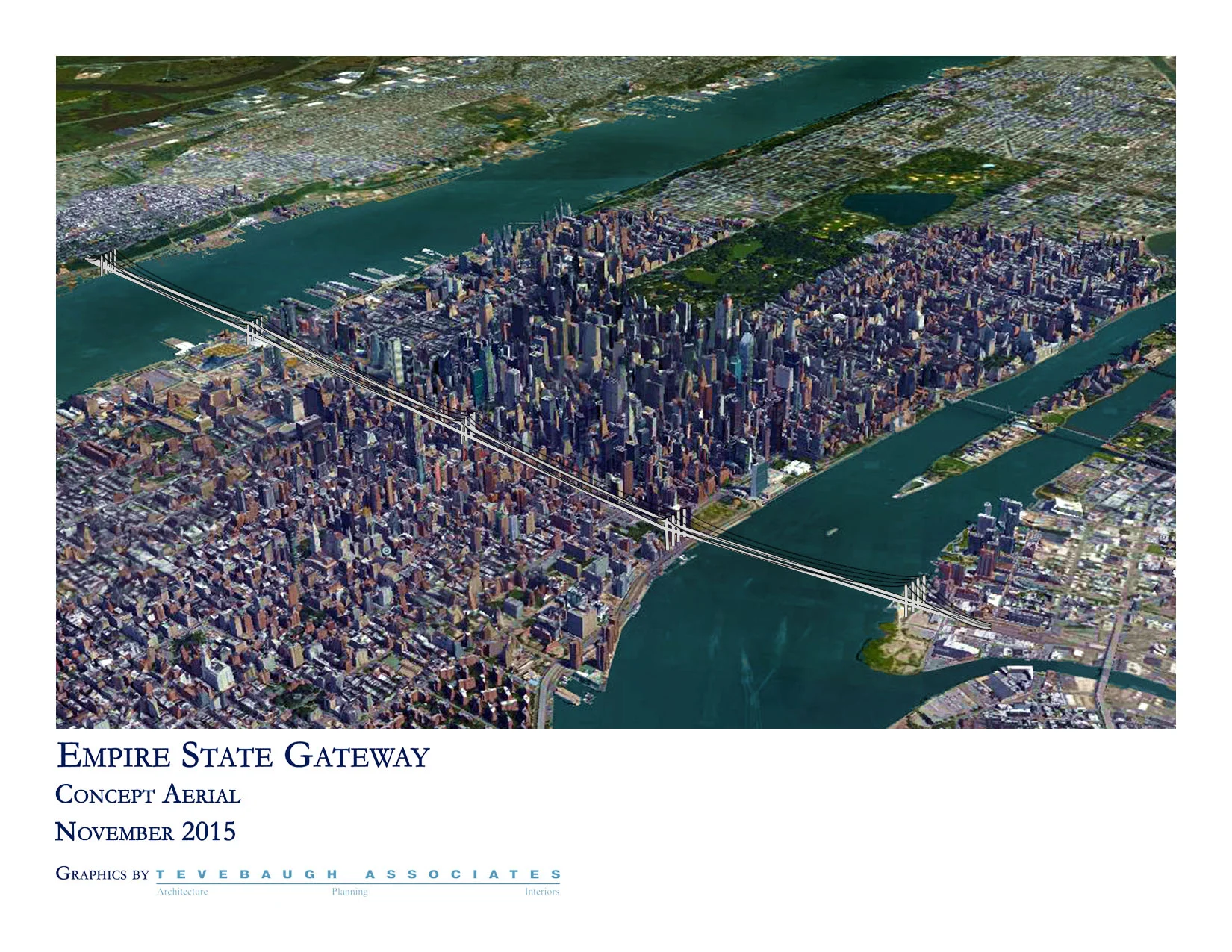
Project Scope
The Empire State Gateway (ESG) is comprised of twin, multi-span suspension and cable-stay bridges connecting New Jersey, New York and New England. Each twin bridge (eastbound and westbound) carries four levels of revenue generating, multi-modal capacity in prefabricated segments:
First Level: Utility Conduit for power, water, gas and telecommunications
Second Level: two tracks for Amtrak and New Jersey Transit trains
Third Level: future Maglev track and two EZ Pass lanes for buses and light rail
Fourth level(top): pedestrians and bikes on the Skyline Trail
ESG Project Advantages over proposed Hudson River Tunnels:
The $20 billion twin Gateway Tunnels only builds two tracks under the Hudson River to Penn Station New York. The new tunnels are highly dependent on federal and New York/New Jersey state funding with limited opportunity to generate non-governmental revenue streams to maximize private financing. The two tunnel tracks end at congested Penn Station. The reliability of the new tunnels for Amtrak and New Jersey Transit trains are dependent on the stability of 100+ year old East River tunnels which have the same structural and aging limitations as the existing Hudson River tunnels.
For approximately the same cost, the Empire State Gateway can be built in less time to create a more resilient, multi-modal transportation infrastructure. The transit only ESG will provide greater transportation capacity (4 tracks, 4 bus/transit lanes, future maglev ROW, hiking/biking trail) to relieve congestion with the current Hudson River tunnels, Penn Station, the East River tunnels and the Lincoln tunnels as well as create far greater revenue streams to maximize opportunities for private investment.